 Foto: Oscar Sánchez / Pexels
Emergency Radios: Best Hand-Crank and Solar Models Compared
Hand-crank, solar, or battery? We compare the best emergency radios for crisis situations.
Why an Emergency Radio Is a Non-Negotiable Piece of Gear
In the first hour of a power outage, you'll reach for your phone. In the second hour, too. But when the cellular network collapses under load — or base stations exhaust their battery backup after 4-6 hours — you'll have no reliable news source left. Except the radio.
FEMA and emergency management agencies across the country specifically recommend battery-powered or hand-crank radios as a core preparedness item. Local emergency broadcast systems, NOAA Weather Radio, and EAS (Emergency Alert System) activations all reach you through radio frequencies when internet infrastructure fails.
In this guide, we compare four emergency radio types and recommend specific models for every situation.
The Four Power Types Explained
Battery-Powered Radios
Classic, reliable, affordable. Battery-powered radios are simple to operate and deliver clear reception. The catch: batteries are finite and must be stockpiled.
Tip: Stock rechargeable AA batteries (like Eneloop) instead of single-use — they can be pre-charged and recharged from solar panels or USB adapters.
Hand-Crank Radios
The emergency preparedness icon. One minute of cranking typically provides 5-20 minutes of use, depending on the model and volume. Requires no external power source, but can be tiring for extended listening sessions.
Solar Radios
Charge via sunlight. Ideal for outdoor use or a sunny windowsill. Significantly limited in winter or overcast conditions. Almost always paired with a hand-crank as backup.
Combination Radios (Crank + Solar + Battery + USB)
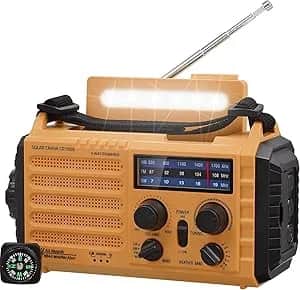
The most versatile option. These devices can use multiple power sources simultaneously or sequentially. Most include a USB output for charging smartphones — an increasingly valuable feature in extended outages. Best overall value for emergency preparedness.
Comparison Table: Top 5 Emergency Radios
| Model | Type | Reception | Crank | Solar | USB Charging | Flashlight | Price (approx.) |
|---|---|---|---|---|---|---|---|
| Sangean MMR-99 | Combination | FM/DAB+ | Yes | Yes | Yes (5W) | Yes | ~$120 |
| Eton FRX5-BT | Combination | FM/AM/DAB+ | Yes | Yes | Yes | Yes | ~$80 |
| Midland ER310 | Combination | FM/AM/NOAA | Yes | Yes | Yes | Yes | ~$55 |
| RunningSnail MD-090 | Combination | FM/AM/NOAA | Yes | Yes | Yes (1A) | Yes | ~$30 |
| Sony ICF-506 | Battery | FM/AM | No | No | No | No | ~$30 |
NOAA vs. FM: What Matters Most in Emergencies
FM Radio: Widely available analog signal, energy-efficient, works on any legacy receiver. Historically more resilient in disasters because the infrastructure is simpler. Local FM stations often provide the fastest on-the-ground information for your specific area.
NOAA Weather Radio (US): Dedicated 24/7 weather and emergency alert broadcasts across 7 frequencies (162.400-162.550 MHz). The most reliable source for official emergency information in the United States — pre-programmed into most combination radios as "WX" channels.
AM Radio: Longer range than FM, especially at night. Useful for receiving distant broadcasts when local stations go dark. Less commonly used day-to-day but valuable as a backup reception band.
Recommendation: Choose a model that covers FM + AM + NOAA/Weather for maximum utility. DAB+ or Shortwave are useful bonuses but not essential for domestic emergency preparedness.
The Right Radio for Each Scenario
For Home Emergency Preparedness
Recommendation: Sangean MMR-99 or Eton FRX5-BT
At home, weight is irrelevant — reception quality and feature set matter. Both models offer FM/DAB+, Bluetooth for everyday use, a strong flashlight, and USB charging for smartphones. The Sangean MMR-99 is the more durable and sonically superior device; the Eton FRX5-BT is a more affordable entry point with nearly identical capabilities.
For a Bug-Out Bag
Recommendation: Midland ER310 or RunningSnail MD-090
In a bag, weight counts. Both models are compact with crank, solar, and USB charging. The Midland ER310 is sturdier and includes NOAA alert capability; the RunningSnail is lighter and significantly cheaper.
As a Dedicated Listening Radio (Minimalist)
Recommendation: Sony ICF-506
For anyone who just wants a reliable FM/AM receiver without the extras: the Sony ICF-506 provides excellent reception and long battery life in a simple, compact package. Great as a supplement to a combination main radio.
Why Radio Wins When Cellular Fails
Modern cellular networks are designed for typical traffic loads. In a disaster, usage spikes dramatically while base stations — running on battery backup — start failing after 4-8 hours without grid power. Internet streaming and cell data disappear.
The broadcast radio system is purpose-built for exactly this scenario:
- Broadcast towers typically carry 72-hour emergency generator fuel
- NOAA Weather Radio and EAS operate on dedicated transmitters hardened against power disruptions
- Local stations often switch to emergency programming instantly, with staff on-site
The bottom line: An emergency radio — whether hand-crank, solar, or combination — costs between $30 and $120 and operates without any external power source. It's one of the cheapest and most reliable investments in your preparedness kit.
Recommended Products
As an Amazon Associate we earn from qualifying purchases. Buying through our links supports the development of this app at no extra cost to you.